
Day Scholar or Boarder? Can Your Child Move Between Day School and Residential Life at PGS?
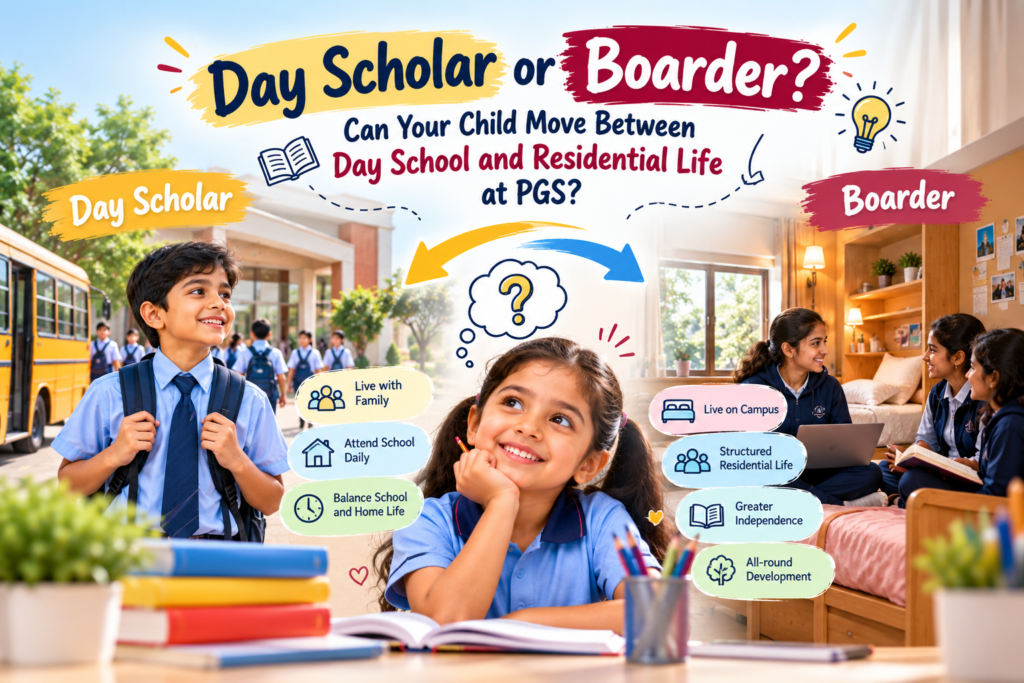
For many families, choosing between day school and boarding feels like a one-time, all-or-nothing decision. But what if your child isn’t ready to live away from home in Grade 4, yet would thrive in a residential setting by Grade 8? Or what if a new job, a transfer or a change at home makes daily travel harder halfway through the school years? At Prachin Global School, the question of day scholar or boarder doesn’t have to be answered once and for all. Because PGS operates as a day and residential school in Hyderabad on a single campus, students can move between the two formats as their needs change — without changing schools, teachers, friends or curriculum. 1 CampusDay & residential 550+Residential students 7.5 AcresKondakal campus 24/7Boarding supervision Continuity Why One Campus Makes the Difference When day scholars and boarders are part of the same school, with the same teachers and the same CBSE curriculum, switching formats changes where a child sleeps and how their evenings are spent — not what or how they learn. That continuity matters. 📖Same Curriculum No new syllabus to adjust to — the CBSE programme carries on exactly as before. 👩🏫Same Teachers No new teachers to get used to, and no lost understanding of how your child learns. 🤝Same Friends No need to rebuild friendships from scratch in the middle of the school years. For a broader look at the two formats, read our guide on day school vs residential school in Hyderabad. This post focuses on what happens when families want to change course. Why Families Switch Common Reasons Families Change Formats From Day School to Boarding Changing family circumstances — a new job, a transfer, travel-heavy work or a move further from campus Long commutes — daily travel time that could instead go into study, sport and rest Senior-school focus — many families choose boarding for Grades 9 to 12, when structured study time becomes especially valuable Growing independence — a child who is ready, and often eager, for more responsibility More time for co-curriculars — boarders have more hours in the week for sports, arts and clubs From Boarding to Day School Moving closer to campus — when daily travel becomes practical again A change at home — parents relocating to Hyderabad or wanting more family time Individual needs — some children, at certain stages, simply do better living at home Moving to day school after boarding is not a step back. It shows that a family and a school are adapting to what a child needs at a particular stage. Reading the Signs Signs Your Child May Be Ready for Boarding They manage everyday routines — getting ready, packing a bag, keeping track of belongings — without constant reminders They settle reasonably well on sleepovers, school trips or camps They show curiosity or enthusiasm about residential life They can tell an adult when something is wrong They respond well to structure and routine No child shows all of these perfectly, and some homesickness is completely normal. Readiness is about direction, not perfection. Signs Day Schooling May Suit Your Child Better Right Now Persistent, intense distress about being away from home that does not ease with time A family situation where being at home matters especially for now A home close enough to campus that daily travel is easy A conversation with your child’s class teacher — and, for boarders, their house parent — is the best way to read these signs accurately. The Process How the Switch Works at PGS Every move is planned around the child. The details depend on your child’s grade and on seat availability, but the process typically looks like this: Talk to UsShare your reasons with the admissions office and your child’s class teacher. Assess Readiness TogetherParents, teachers and house parents discuss whether the move suits your child now. Visit the Boarding HouseFor a move into boarding, your child sees the rooms, dining hall and study areas, and meets the house parents and current boarders. Plan the TimingMoves are usually easiest at the start of a term, so your child settles into a fresh routine. Review the Practical DetailsThe admissions office explains what changes in the daily schedule, transport and fees. Settle In with SupportHouse parents and teachers check in closely during the first weeks. For Parents Tips to Make the Transition Smooth 🗨️Involve Your Child Children settle faster when they feel heard in the decision. 😊Stay Positive and Honest Acknowledge that change can feel strange at first. 🧸Pack Familiar Items A favourite blanket, photographs or books help a new room feel like home. 📞Agree on a Contact Routine Predictable calls tend to work better than constant contact in the early weeks. 🏠Partner with House Parents They are your partners in your child’s wellbeing — stay in touch. ⏳Give It Time Most children need a few weeks to settle into a new routine. Residential Life Life as a PGS Boarder — What Changes, and What Doesn’t Boarders at PGS follow a structured daily routine of morning exercise, classes, co-curricular activities, supervised evening study and rest. They live in separate boarding houses for boys and girls, supervised by dedicated house parents, with nutritionist-planned meals and 24/7 staff supervision. What doesn’t change is the classroom: the same teachers, the same curriculum and the same friends. It is this combination of flexibility and continuity that places PGS among the best residential schools in Hyderabad for families whose needs change over time. Read more about daily life on our residential life page. FAQs Frequently Asked Questions Is moving from day school to boarding a big adjustment? There is an adjustment, but it is smaller when the school stays the same. Your child already knows the campus, the teachers and many classmates, so the only new elements are the boarding routine and evenings with house parents. Will switching affect my child’s studies? It shouldn’t. The curriculum, teachers and assessments stay the same. Many families find that the supervised evening study in
From STEM Lab to IIT: How Early Exposure Builds JEE & NEET Readiness
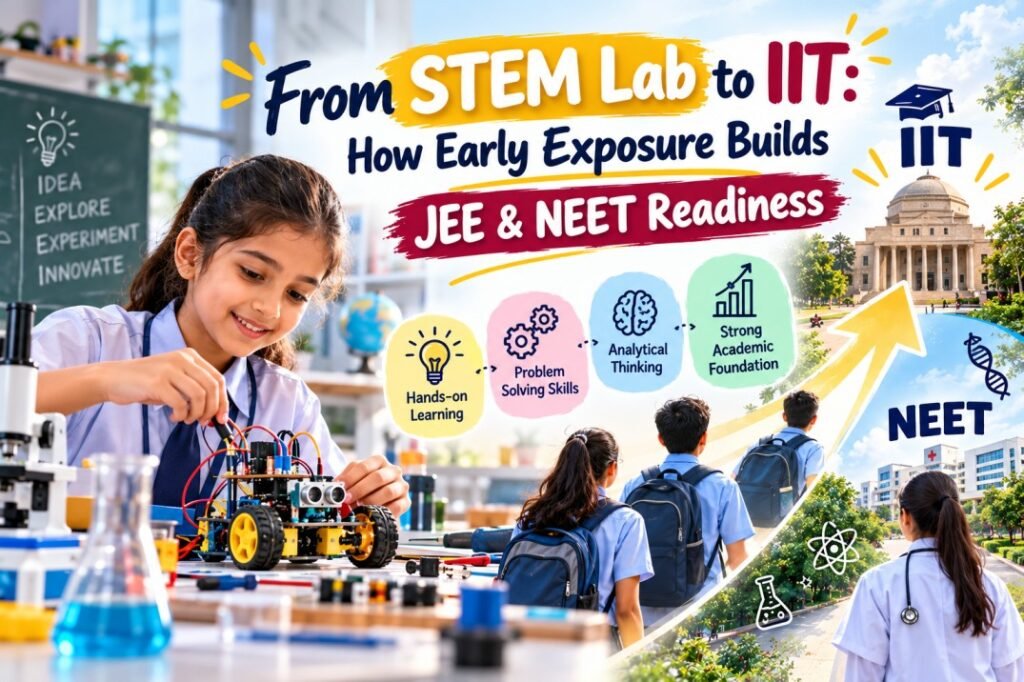
Ask any IIT or AIIMS student when their preparation really started, and many will say it was long before Grade 11. The concepts tested in JEE and NEET — mechanics, electricity, chemical bonding, cell biology, algebra and calculus — rest on foundations laid in Grades 6 to 10. Children who understood those basics deeply, rather than memorising them for a test, find the step up to competitive exam preparation far less daunting. This is where a strong JEE and NEET foundation begins: not with early coaching, but with curiosity, clear concepts and hands-on learning. Here is how early STEM exposure builds genuine JEE and NEET readiness, and how parents can support that journey at every stage. Grades 6–10The foundation years NCERT 11–12Basis of JEE & NEET 75%Class 12 marks for IIT/NIT eligibility DailySTEM Lab use at PGS The Exams Understanding JEE and NEET JEE Main is the national engineering entrance exam conducted by the National Testing Agency (NTA). It is the gateway to NITs, IIITs and other centrally funded institutions, and top-ranked candidates qualify for JEE Advanced, the exam for admission to the IITs. NEET-UG, also conducted by the NTA, is the single national entrance exam for MBBS, BDS and other undergraduate medical courses. JEE (Engineering) NEET-UG (Medical) Conducted by National Testing Agency (JEE Main); IITs (JEE Advanced) National Testing Agency Subjects Physics, Chemistry, Mathematics Physics, Chemistry, Biology Leads to NITs, IIITs, other centrally funded institutions; IITs via JEE Advanced MBBS, BDS and other undergraduate medical courses Syllabus base Largely NCERT Classes 11 and 12 Largely NCERT Classes 11 and 12 Why Early Matters Why the Foundation Years (Grades 6–10) Matter The CBSE curriculum is designed as a spiral: concepts introduced in middle school return in greater depth in Grades 9, 10, 11 and 12. A student who truly understands force and motion in Grade 9 will find rotational dynamics in Grade 11 manageable. One who only memorised formulas will struggle, and may spend Grade 11 relearning basics while classmates move ahead. Strong foundations in these years come down to three things: 💡Conceptual Clarity Understanding why a formula works, not just how to apply it. ➗Mathematical Fluency Comfort with fractions, ratios, algebra, geometry and graphs. 🔬Scientific Thinking The ability to form a hypothesis, test it and interpret the result. Learning by Doing What a STEM Lab Adds That Textbooks Cannot Textbooks describe phenomena; a STEM lab lets children see, measure and question them. When a student builds a pulley system, wires a simple circuit or tests acids and bases with indicators, an abstract idea becomes something they have experienced. That kind of understanding is exactly what the application-based questions in JEE and NEET reward. STEM Lab Activity (Middle School) Concept It Builds Where It Reappears Building levers, pulleys and simple machines Force, work, mechanical advantage JEE Physics — laws of motion, work–energy, rotational motion Wiring circuits with cells, bulbs and switches Current, resistance, series and parallel connections JEE and NEET Physics — current electricity Acid–base and indicator experiments Chemical reactions, pH, neutralisation JEE and NEET Chemistry — equilibrium and physical chemistry Observing plant and animal cells under a microscope Cell structure and function NEET Biology — cell biology and physiology Coding and data-logging activities Logic, sequencing, interpreting data JEE Mathematics — analytical problem-solving Measurement and error experiments Precision, units, significant figures JEE and NEET Physics — units, measurement and practical skills Our earlier post on how STEM education shapes future-ready children explains the PGS STEM Lab programme in more detail. Beyond Knowledge The Skills Competitive Exams Really Test JEE and NEET are not just knowledge tests. Strong candidates consistently combine four skills, and all four can be developed in school: 🧩Application Using a concept in an unfamiliar situation — which project-based STEM work trains directly. ⏱️Speed with Accuracy Built through regular, timed practice rather than last-minute cramming. 🧠Analytical Reasoning Breaking a complex problem into smaller, solvable steps. 📈Consistency Steady study habits sustained over two or more years. For Parents A Grade-by-Grade Roadmap for Parents Grades 6–8 Build Curiosity and Fundamentals Focus on enjoying Science and Mathematics. Encourage hands-on projects, reading and questions. Taking part in Science and Mathematics Olympiads at this stage builds problem-solving confidence without pressure. Heavy coaching is unnecessary here and often counterproductive. Grades 9–10 Strengthen the Core These years introduce the foundations of most Class 11 and 12 topics. Make sure your child genuinely understands NCERT Science and Mathematics, practises numerical problems regularly and builds good study habits. Strong Grade 10 board results also give students confidence going into the senior years. Grades 11–12 Focus and Balance With the choice of stream — PCM for engineering, PCB for medicine — preparation becomes more focused. Students need to balance board preparation with entrance preparation, practise with previous years’ papers and mock tests, and revise steadily. Board marks still matter: admission to IITs, NITs and IIITs generally requires at least 75% in Class 12 (65% for SC/ST candidates) or a top-20-percentile board score. Learn more about senior secondary education at PGS. Residential Advantage How Residential Life Supports Exam Preparation Preparing for JEE or NEET takes sustained effort over years. A structured residential routine — fixed study hours, supervised evening study, fewer distractions and no daily commute — can make that consistency easier to maintain. At PGS, residential students follow supervised evening study sessions with access to the labs and library. Read more about residential life at PGS. The PGS Approach How Prachin Global School Builds the Foundation A daily-use STEM Lab, plus dedicated Physics, Chemistry, Biology, Mathematics and Computer labs Hands-on CBSE practical work aligned with the NCERT syllabus Encouragement to take part in Science and Mathematics Olympiads and competitions A digital library with over 10,000 titles for independent study CBSE education from Nursery to Grade 12 on one campus, so foundations are built consistently year after year A Word of Caution — Avoid Burnout Early exposure should mean early curiosity, not early pressure. Children pushed into intensive coaching too young often lose interest in the very subjects
CBSE vs IB vs Cambridge — Which School Board Is Right for Your Child in Hyderabad? (2026 Comparison)
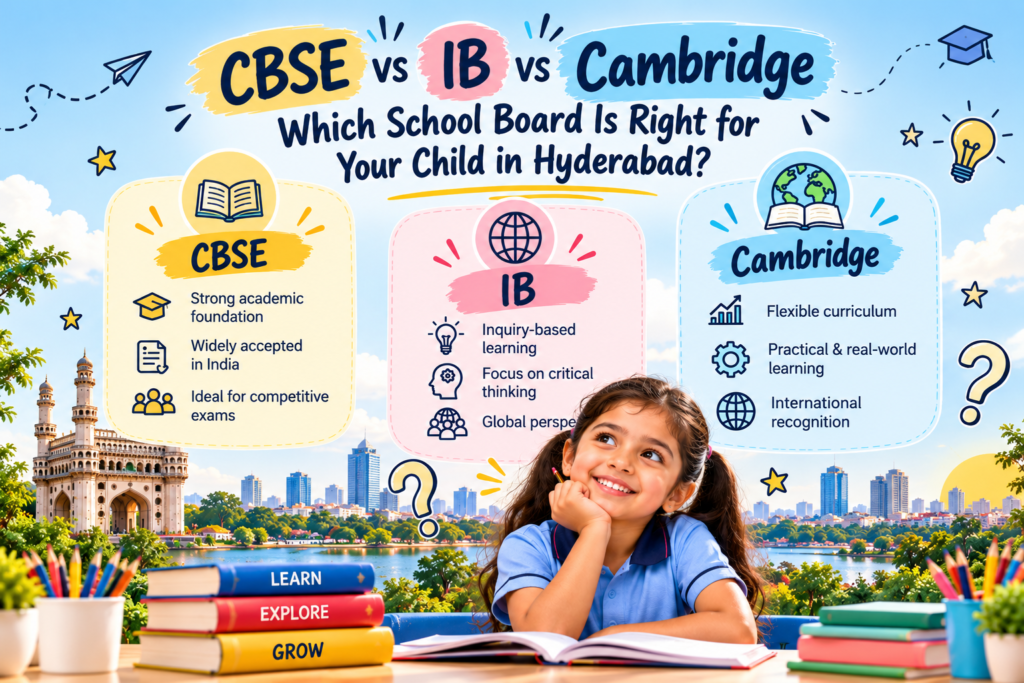
Hyderabad parents today have more choice of school board than any previous generation. Alongside the familiar CBSE and state boards, the city now has a growing number of schools offering the International Baccalaureate (IB) and Cambridge International curricula. If you are weighing CBSE vs IB vs Cambridge for your child, the decision can feel bigger than choosing a school, because the board shapes how your child learns, how they are assessed, and which doors open after Grade 12. This 2026 guide compares the three boards side by side — curriculum, assessment, entrance exam alignment, recognition and mobility — so you can choose the board that fits your child and your family’s plans, not just the one with the most impressive brochure. 30,000+CBSE-affiliated schools 3Boards compared NCERTBase of JEE, NEET & CUET Nursery–12CBSE at PGS The Basics Three Boards, Three Different Philosophies 📘CBSE — India’s National Board The Central Board of Secondary Education is India’s largest school board, with more than 30,000 affiliated schools across India and overseas. Its NCERT-based curriculum leads to board exams in Grades 10 and 12, and since NEP 2020 it has moved steadily towards competency-based, application-led learning. 🌐IB — The International Baccalaureate A Geneva-based foundation offering the PYP (ages 3–12), MYP (11–16), and the Diploma and Career-related Programmes (16–19). Learning is inquiry-led and interdisciplinary; Diploma students also complete Theory of Knowledge, an Extended Essay and CAS. 🎓Cambridge International Part of Cambridge University Press & Assessment, UK. Its pathway runs from Primary and Lower Secondary to IGCSE (ages 14–16) and AS & A Levels (16–19), and is known for wide subject choice and in-depth, exam-based assessment. Side by Side CBSE vs IB vs Cambridge — Side-by-Side Comparison Factor CBSE IB Cambridge Governing body Central Board of Secondary Education, India International Baccalaureate Organization, Geneva Cambridge University Press & Assessment, UK Learning approach Structured and NCERT-based, moving to competency-based learning under NEP 2020 Inquiry-based, interdisciplinary, student-led projects Subject-focused, flexible subject combinations, in-depth content Key assessments Grade 10 and Grade 12 board exams, plus internal assessment and practicals Internal assessments and final DP exams, plus Extended Essay and TOK IGCSE exams (around Grade 10) and AS & A Level exams JEE / NEET / CUET alignment Direct — entrance syllabi are based on NCERT Classes 11–12 Indirect — NCERT content usually needs separate preparation Indirect — NCERT content usually needs separate preparation Indian university recognition Accepted everywhere Accepted, with equivalence through the Association of Indian Universities (AIU) Accepted, with equivalence through the AIU Availability across India Largest network — easy transfers between cities Limited, mostly in large metros Moderate, mostly in large metros Best suited for Families planning higher education in India, or who may relocate within India Families planning undergraduate study abroad, with a child who enjoys self-directed work Families wanting subject flexibility, often with plans to study abroad Entrance Exams Entrance Exams — Where the Board Choice Matters Most For most Indian families, the biggest practical difference between boards shows up in Grades 11 and 12. India’s major national entrance exams — JEE Main for engineering, NEET-UG for medicine and CUET-UG for central university admissions — are conducted by the National Testing Agency, and their syllabi are drawn largely from NCERT content for Classes 11 and 12. A CBSE student prepares for the board exam and the entrance exam from the same textbooks. An IB or Cambridge student can certainly sit these exams, but usually has to study NCERT content separately, often alongside a demanding international programme. Board marks still count for JEE Admission to IITs, NITs and IIITs generally requires at least 75% in Class 12 (65% for SC/ST candidates) or a top-20-percentile score in the student’s board, in addition to the JEE rank. If there is a realistic chance your child will aim for an IIT, NIT, AIIMS or another top Indian institution, CBSE removes an entire layer of extra work. Relocation Mobility and Continuity Many Hyderabad families — especially those in IT, pharma and corporate roles — relocate within India at some point. With more than 30,000 CBSE schools across the country, a CBSE student can move cities and continue with the same curriculum and textbooks. IB and Cambridge schools are far fewer and concentrated in large metros, so a mid-school move can mean switching boards, which is disruptive at any age and especially in Grades 9 to 12. Making the Call Which Board Fits Your Family? When IB or Cambridge May Be the Better Fit Your family is firmly planning undergraduate study abroad, particularly in the UK, Europe or North America You are likely to relocate internationally during your child’s school years Your child thrives with a high degree of independence and open-ended, research-led work When CBSE Is the Strongest Choice Your child may aim for JEE, NEET, CUET or other Indian entrance exams You want a nationally recognised board with the widest choice of schools and colleges Your family may relocate within India You want a structured curriculum that is becoming more hands-on and application-based under NEP 2020 Many students also go on to study abroad successfully from CBSE schools, so this is a question of fit, not of ceiling. For most Hyderabad families, CBSE offers the best balance of academic rigour, flexibility and long-term options. That is why the question most parents eventually move on to is not which board, but which CBSE school. Next Step Choosing the Right CBSE School in Hyderabad Once you have settled on CBSE, the quality of the individual school matters more than the board itself. Whether you are searching for CBSE top schools in Hyderabad or comparing lists of the best schools in Hyderabad CBSE parents recommend, look beyond rankings. Check the affiliation status, board results over the last three years, lab infrastructure, teacher stability and the depth of the co-curricular programme. Our detailed guide to choosing the best CBSE school in Hyderabad walks through each of these. The PGS Approach Why Prachin Global School Chose CBSE At Prachin Global School (PGS), we follow the
CBSE School Admission FAQs: Every Question Hyderabad Parents Ask, Answered
Every admission season, Hyderabad parents ask our admissions team many of the same questions — about age criteria, documents, admission interactions, mid-year transfers, transport and boarding. We have gathered the most common ones into this guide of CBSE school admission FAQs, so you can plan your child’s CBSE admission in Hyderabad with confidence before you visit any school. For a step-by-step walkthrough of the process itself, read our CBSE school admission process guide. This post answers the questions that come up along the way. 17Parent questions answered Oct–MarTypical admission window Nursery–12Grades at PGS Day & BoardingBoth options on one campus In This Guide Planning Ahead Applying and Documents Transfers and Board Changes Fees, Transport and Campus Life Section 1 Planning Ahead When do CBSE school admissions open in Hyderabad? Most CBSE schools in Hyderabad run admissions for the next academic year between October and March. Popular grades — especially Nursery, Grade 1, Grade 6 and Grade 11 — and residential seats tend to fill early, so it is wise to start enquiring several months ahead. What is the right age for Nursery and Grade 1 admission? Age criteria are set in line with CBSE norms and state government guidelines, and are calculated as of a cut-off date in the admission year. NEP 2020 recommends that children begin Grade 1 at age 6, after three years of pre-school, and the Ministry of Education has asked states to align their age criteria with this. Because these guidelines are being implemented in phases, always confirm the exact age cut-off for your child’s grade directly with the school. Can my child join in the middle of the academic year? Yes. Mid-year admissions are generally possible, particularly for families relocating to Hyderabad, subject to seat availability and a valid Transfer Certificate from the previous school. Should I choose a day school or a residential school? It depends on your child’s readiness, your family’s routine and how far you live from school. Our guide to day school vs residential school in Hyderabad can help you decide. Section 2 Applying and Documents How do I apply for admission at Prachin Global School? Fill the online enquiry form on our admissions page, call +91 9393778778, or visit our admissions office at Kondakal Village, Shankarpally Mandal. Our team will guide you through the next steps and arrange a campus visit. What documents are required for CBSE school admission? The typical list includes: Child’s birth certificate (original and photocopy) Transfer Certificate (TC) from the previous school — not required for fresh Nursery admissions Previous year’s report card or progress report Aadhaar card copies of the child and both parents Passport-size photographs of the child Medical fitness certificate from a registered doctor APAAR ID, if one has already been generated Caste certificate, if applicable Requirements vary slightly by grade, so confirm the final list with the admissions office. What is an APAAR ID, and do I need one? APAAR (Automated Permanent Academic Account Registry) is a unique student ID introduced under NEP 2020’s “One Nation, One Student ID” initiative, used to keep a child’s academic records digitally. If your child already has one from their previous school, share it at admission; if not, the school can guide you through generating it. Is there an entrance test? At PGS, admission involves a friendly interaction rather than a high-pressure exam. For Nursery to Grade 2, it is a short, playful session. For Grade 3 and above, it usually covers English reading and comprehension and basic Mathematics, so we can understand your child’s current level and place them well. Does my child need coaching for the admission interaction? No. There is no separate syllabus to study. We want to see your child’s genuine current level, and regular reading and everyday conversation at home are the best preparation. For younger children, see our guide on how to prepare your child for Grade 1 admission. Will parents also be interviewed? Our admissions team meets parents to understand your child and your expectations, answer your questions and explain how the school works. It is a conversation, not a test. Section 3 Transfers and Board Changes Can my child switch from the State Board or ICSE to CBSE? Yes. Students move to CBSE from other boards regularly, and the transition is easiest before Grade 9. Teachers help new students bridge any gaps in subjects where the syllabi differ. Can my child get admission directly into Grade 10 or Grade 12? Generally not. Grade 10 and Grade 12 are CBSE board examination years, and direct admission into them is permitted only in specific circumstances, such as a family relocation, usually with CBSE approval. If you are planning a move, try to complete it before Grade 9 or Grade 11. Which streams are available in Grade 11? CBSE schools typically offer Science, Commerce and Humanities, though the subject combinations vary by school. At PGS, our senior secondary programme offers Science, Commerce and Humanities streams for Grades 11 and 12 — ask the admissions team about the subject combinations available for your child’s year. Section 4 Fees, Transport and Campus Life What are the fees? Fees vary by grade and by whether your child is a day scholar or a residential student. For the current fee structure, please contact our admissions office on +91 9393778778 — the team will share a full, transparent breakdown. Is school transport available? Yes. PGS operates GPS-enabled, air-conditioned school buses with safety staff on board. Routes and stops can be confirmed with the admissions team. How are residential students cared for? Residential students live in separate boarding houses for boys and girls, supervised by dedicated house parents, with 24/7 staff supervision, nutritionist-planned meals and supervised evening study. Learn more on our residential life page. What happens after admission is confirmed? You will receive an admission letter and an orientation guide covering the uniform, booklist, timetable and transport options, so your child’s first day goes smoothly. Still have a question that isn’t answered here? Our admissions
10 Signs You’ve Found the Right CBSE School in Hyderabad
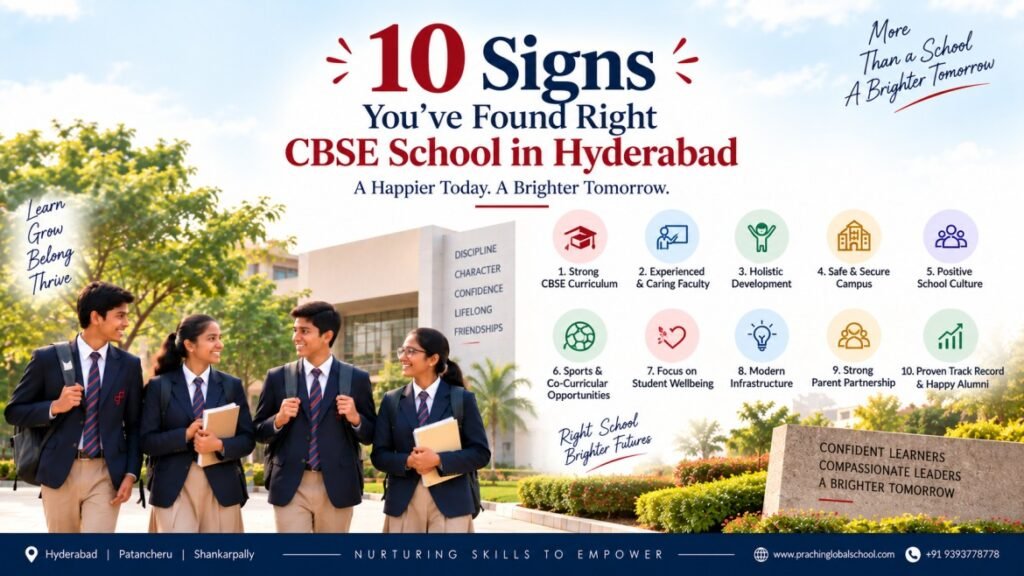
A practical checklist for parents comparing CBSE schools beyond the brochure. Hyderabad has no shortage of schools claiming to be among the best schools in Hyderabad CBSE has to offer — but glossy websites and long facility lists don’t always tell you what actually matters. After years of visiting campuses and talking with parents across the city, here are 10 genuine signs that a school is the right one, not just the most marketed one. 1 Teachers Who Have Been There for Years High teacher turnover is one of the clearest red flags in Indian schooling. Ask directly: how long have most teachers been at the school? Strong, stable schools retain their staff — because good teachers stay where they’re supported. 2 A Student-Teacher Ratio That Actually Holds Up Many schools quote an aspirational ratio on their website but run much larger classes in practice. Ask to sit in on a class, or simply count the students yourself during a campus visit. 3 Labs That Are Used, Not Just Displayed A STEM lab or science lab that’s spotless and empty during a tour is usually a lab that’s rarely used. Ask when it was last used, by which grade, and for what project. 4 Transparent, Verifiable Board Results The right school will happily share Grade 10 and Grade 12 pass percentages and average scores from recent years — not just headline toppers, but overall performance trends. 5 A Real Answer About Safety and Supervision Whether it’s a day school or residential campus, ask specifically who supervises students during unstructured time, and what the safeguarding protocol looks like. A confident, specific answer is a good sign; a vague one is not. 6 Co-Curricular Activity That Isn’t Just a Poster Sports, arts, and music shouldn’t be a once-a-term photo opportunity. Ask how often these activities actually run during a normal week. 7 A Curriculum Aligned with Where Students Are Headed For CBSE schools, alignment with NEP 2020 and clear preparation for competitive exams like JEE, NEET, and CUET is a strong signal that the school is genuinely preparing students for what comes after Grade 12. 8 Honest Admissions Conversations The right school’s admissions team will discuss both strengths and trade-offs honestly, rather than making every question sound like a sales pitch. 9 A Campus That Feels Lived-In, Not Just Photographed Genuine wear and use — a slightly scuffed sports field, well-thumbed library books — is often a better sign than an unnaturally pristine campus that never seems to have students in it during your visit. 10 Parents Who Speak Positively Without Being Asked Ask the admissions team to connect you with a few current parents. Schools confident in their community are usually happy to do this without hesitation. Where Prachin Global School Fits At Prachin Global School, we encourage every one of these questions during a campus visit — teacher tenure, lab usage, board results, and direct conversations with current parents. With over 1,800 students and 15 years of building trust with Hyderabad families, we’d rather you decide with real information than a brochure alone. Our complete parent’s guide to choosing a CBSE school covers the fuller picture if you’d like to go deeper. Related reading Best CBSE Schools in Hyderabad 2026 — A Complete Parent’s Guide CBSE School Admission Process 2026-27 in Hyderabad See these signs for yourself. Book a campus visit at Prachin Global School. Visit prachinglobalschool.com/admissions/ | Call +91 9393778778
How Residential Schools Support Student Health & Wellbeing
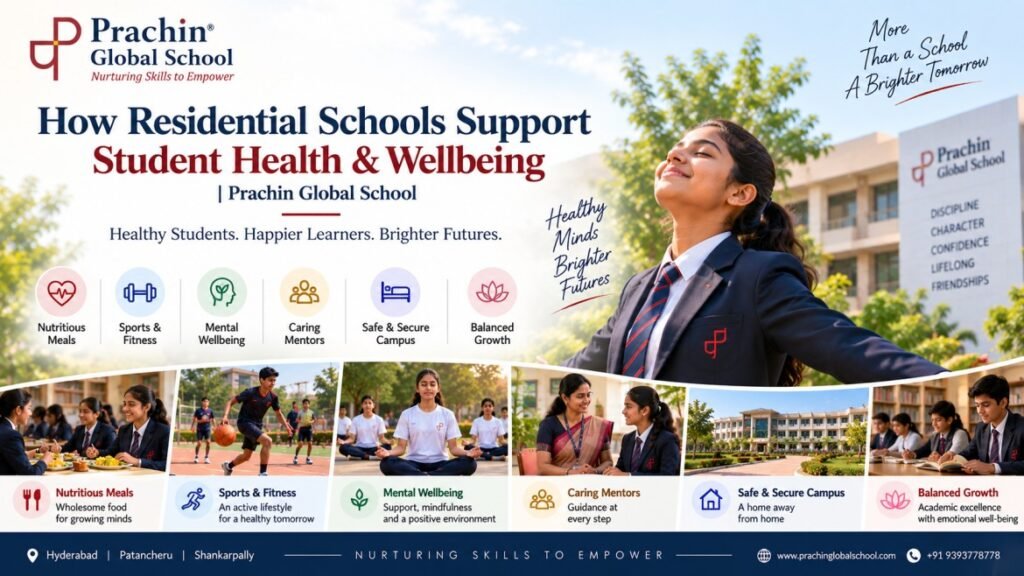
A closer look at how nutrition, sleep, safety, and emotional wellbeing are managed in a residential setting. When parents consider the best boarding schools in Hyderabad, academics and facilities usually top the list — but health and wellbeing deserve just as much attention. A residential school isn’t just responsible for a child’s education; it’s responsible for their daily physical and emotional wellbeing, every single day of the term. Why Wellbeing Looks Different in a Residential Setting At a day school, a great deal of a child’s physical and emotional care happens at home — meals, sleep routines, and emotional check-ins are managed by parents. In a residential school, the school itself takes on much of this responsibility. That’s a significant trust to place in an institution, and it’s worth understanding exactly how that trust is earned. Our post on a typical day for a residential student shows how this plays out hour by hour. 1 Nutrition Consistent, supervised, and balanced. Every meal — breakfast, lunch, evening snacks, and dinner — is nutritionist-supervised at PGS, regardless of what a typical home routine might look like during a busy week. 2 Sleep A predictable, healthy schedule. Fixed wake-up and lights-out times support academic performance and emotional regulation, without disruption from late-night screen time. 3 Physical Activity Built into the day, not an afterthought. With more available hours than a day scholar managing a commute, sport, yoga, and outdoor time are genuine daily habits. 4 Emotional Wellbeing Some homesickness in the first weeks is completely normal. Dedicated house parents who know each student individually make all the difference during this adjustment. 5 Safety & Supervision A secure campus with 24/7 staff oversight and clear safeguarding protocols means wellbeing is looked after outside of structured class time too. 6 Community The friendships formed in a residential environment create a natural emotional support system many students carry with them well beyond school. What This Looks Like at Prachin Global School At PGS, our residential programme is built around exactly these principles: nutritionist-supervised meals in a large dining hall, dedicated house parents for boys’ and girls’ boarding houses, a secure 7.5-acre campus with round-the-clock supervision, and a daily routine that balances academics, activity, and genuine rest. Parents new to residential schooling often start with our overview of the seven proven benefits of residential schooling before visiting campus. Related reading A Day in the Life of a PGS Residential Student Day School vs Residential School in Hyderabad — How to Decide See our residential facilities and meet our house parents in person. Visit prachinglobalschool.com/residential-life/ | Call +91 9393778778
Day School vs Residential School in Hyderabad — How to Decide What’s Right for Your Child

A practical, honest comparison to help Hyderabad parents choose the right format for their child. For many Hyderabad parents, the decision between a day school and a residential school isn’t about which is objectively “better” — it’s about which is better suited to their specific child, family routine, and long-term goals. Both formats can produce confident, well-rounded students. The right choice depends on a handful of honest questions most parents don’t get asked directly. What Actually Changes Between Day School and Residential School When families search for the best residential schools in Hyderabad, they’re often comparing on facilities and fees alone. But the deeper differences are structural: how the day is organised, how much independence a child builds, and how much day-to-day parental involvement is realistic given work schedules and travel distance. Factor Day School Residential School Daily structure Split between school and home Single consistent routine managed by the school Independence Builds gradually, often later Builds early, especially from Grade 6 onward Study consistency Varies with home environment Supervised evening study every day Family time Daily Weekends / scheduled visits Best suited for Younger children, home-oriented families Structure-seeking children, long commute situations 1. Daily Structure and Time Day school students split their day between school and home, with parents typically managing homework time, extracurricular scheduling, and bedtime routines. Residential students follow a single, consistent daily structure — set study periods, supervised evening revision, and consistent sleep schedules — managed by the school itself. Our post on a real day in the life of a residential student walks through exactly what this looks like, hour by hour. 2. Independence and Self-Management This is often the single biggest differentiator. Residential students, particularly from Grade 6 onward, develop independence at a noticeably faster pace: managing their own time, belongings, and small daily problems without a parent stepping in. Day school students typically build this independence later, often not until college. 3. Academic Consistency Among best boarding schools in Hyderabad, one advantage that consistently comes up is uninterrupted academic rhythm. Without the distractions of home — television, unstructured evenings, sibling activity — supervised study periods in a residential setting tend to be more consistent throughout the year, not just concentrated before exams. 4. Family Time and Emotional Considerations Day school naturally preserves more daily family time, which matters most for younger children and for families who value being closely involved in day-to-day school life. Residential school requires an adjustment period, and it’s not the right fit for every child or every family circumstance — this is worth an honest conversation before deciding, not after. 5. Cost of Commute vs Cost of Distance For families living far from strong day-school options — including many in the Patancheru and Shankarpally belt — a long daily commute has its own hidden cost: lost study time, tired evenings, and less time for extracurriculars. In these cases, a residential school closer to a good campus can actually mean more usable time for the child, not less. A Simple Way to Decide If your child thrives with routine and structure, and independence is a priority — residential schooling tends to suit them well. If your family values daily involvement and your child is younger or more home-oriented — day school may be the better current fit. If your commute is genuinely long (over 45–60 minutes each way), the time recovered through residential schooling is worth factoring in. If you’re unsure, a phased approach — visiting a residential campus, speaking with current residential parents, and observing a typical day — usually makes the decision much clearer. How Prachin Global School Supports Both Conversations At Prachin Global School, our admissions team regularly walks parents through exactly this decision — honestly, without steering families toward residential life if it isn’t the right fit yet. Our residential programme includes structured evening study, dedicated house parents, and a genuine home-away-from-home environment for students who are ready for it. Many parents also find it helpful to read about the seven proven benefits of residential schooling before making their decision. Related reading A Day in the Life of a PGS Residential Student How Residential Schools Support Student Health & Wellbeing Not sure which format is right for your child? Book a campus visit and speak with our admissions team. Visit prachinglobalschool.com/admissions/ | Call +91 9393778778
Best CBSE Residential School Near Patancheru & Shankarpally — A Local Parent’s Guide (2026)
If you live in or around Patancheru or Shankarpally, the school decision looks a little different than it does for a family in the city centre. You’re not choosing between “residential or day” in the abstract — you’re weighing an actual daily commute, actual traffic patterns, and the actual rhythm of local life against what a CBSE residential school near Patancheru or a CBSE residential school near Shankarpally could offer instead. This guide is written specifically for that decision, not a general facilities tour. The Local Question: Day School Commute vs. Residential Life For families already based in this corridor, the “why residential?” conversation usually starts with a practical observation: even a short commute on local roads during peak hours eats into a child’s evening — homework, rest, and family time all get compressed. Parents in Patancheru and Shankarpally often find that a residential arrangement, even for a child who technically lives close by, gives back structured time that a daily commute quietly takes away. This is different from the reasons a family relocating from across Hyderabad might choose residential — for local families, it’s less about distance and more about reclaiming a predictable daily rhythm. If you want the fuller facilities picture first, our campus overview covers what a typical day actually includes. What Local Parents Ask Before Deciding “Is residential really necessary if we live nearby?” Not always — but for families managing long work hours or irregular schedules, it often means more consistent supervision than a day-school routine can guarantee. “Can my child come home on weekends?” Yes — being local means weekend visits are genuinely easy, unlike families boarding from other cities or states. “Will they lose touch with local friends?” Many residential students at PGS are themselves from Patancheru and Shankarpally, so local friendships continue both on campus and at home. “What if we change our mind later?” Because the campus is local, transitioning between day and residential status is a simpler conversation than it would be for an out-of-town family. Why Being Local Changes the Residential Decision A family from Patancheru or Shankarpally choosing a residential CBSE school nearby gets something an out-of-town family doesn’t: the ability to start with day school, observe, and transition to residential later if it makes sense — without uprooting the child’s local social world. It also means emergency visits, weekend pickups, and parent-teacher meetings are all a short drive away, not a planned trip. This local flexibility is one of the most underrated advantages of choosing a residential option close to home rather than in a different part of the city. Explore the specifics of daily boarding life in our guide to what makes a boarding school truly excellent. Making the Decision as a Patancheru or Shankarpally Family Start by being honest about what’s actually driving the consideration — commute fatigue, irregular work hours, a desire for more structure, or simply wanting your child to have the residential experience while staying close to home. Visit the campus, talk to other local families who’ve made the switch, and ask specifically how the school supports local residential students differently from those boarding from further away. If your child is entering Grade 11 or 12, the considerations shift again — see our dedicated guide on choosing a residential programme for senior secondary students. Related Reading Explore Our Patancheru & Shankarpally Campus → What Makes a Boarding School Truly Excellent → Best CBSE Residential Schools for Grade 11 & 12 → Still Deciding? Talk to a Local Family We can connect you with current Patancheru and Shankarpally residential parents before you decide. Book a Campus Tour → Or call +91 9393778778
Why Prachin Global School Is Anchoring Hyderabad’s Growing West Zone Education Hub
Why Prachin Global School Is Anchoring Hyderabad’s Growing West Zone Education Hub | Prachin Global School Our Campus Shankarpally & Patancheru Community & Location · 5 min read · Prachin Global School Ask a Hyderabad parent living in Gachibowli or Kondapur where the city’s education landscape is expanding, and increasingly the answer points west — towards Patancheru and Shankarpally. As families search for the best schools in Patancheru and the best schools in Shankarpally, they are discovering a corridor that offers space, calm, and room for a school to build a genuinely large, well-equipped campus. Why the West Zone Is Hyderabad’s Fastest-Growing Education Corridor Hyderabad’s IT and residential growth has steadily pushed westward — through Kokapet, Gachibowli, Miyapur, and Kukatpally — towards Patancheru and Shankarpally. This shift brings families who are looking for exactly what this corridor offers: larger campuses, cleaner air, and schools built with room to grow. A school built on 7.5 acres in Shankarpally can offer sports fields, two swimming pools, and dedicated performing arts studios in a way that is structurally difficult for a school on a compact city-centre plot to replicate. See the full scope of what that space enables in our overview of PGS’s extracurricular programme. Prachin Global School’s Role in the Corridor’s Growth PGS was established in Kondakal Village, Shankarpally Mandal, in 2010 — early in this corridor’s growth story. Since then, the school has expanded from 66 students to over 1,800, becoming one of the anchor institutions that has itself helped attract families to the area. A second campus at Jayalaxmi Nagar, Beeramguda extends this presence further into the growing western belt. ★ Founded 2010 Among the corridor’s earliest established CBSE schools, in Kondakal Village, Shankarpally Mandal. ★ 1,800+ students Grown steadily across Nursery to Grade 12 through sustained parent trust. ★ Two campuses Main 7.5-acre campus plus a second campus at Jayalaxmi Nagar, Beeramguda. ★ Full CBSE curriculum Residential and day-school options for families across the west zone. What This Means for Families Comparing Schools Across Hyderabad For a family weighing a school in the city centre against one in this western corridor, the calculation increasingly favours the corridor: shorter commutes as more IT campuses relocate west, larger and safer campuses, and a growing density of established institutions. Families researching the top schools in Hyderabad overall are increasingly finding that some of the strongest campus infrastructure in the city now sits precisely in this westward belt. A Community Built Around the School Unlike a city school that draws students from across a sprawling metro area, PGS anchors a genuine local community — residential students from across Telangana and beyond, day students from the immediate Shankarpally and Patancheru neighbourhoods, and a growing network of families who chose to relocate near the campus specifically for school access. Our residential programme plays a central part in that community. Looking Ahead — Shankarpally and Patancheru as an Education Destination As Hyderabad continues its westward expansion, schools already established in this corridor — with room to grow, invest, and build genuine campus infrastructure — are positioned to lead the city’s next chapter of education growth. PGS intends to remain at the centre of that story. Related Reading Best CBSE Schools in Hyderabad 2026 — A Complete Guide → What Makes a Boarding School Truly Excellent → Top CBSE Schools in Hyderabad — What Rankings Measure → Visit Our Shankarpally Campus Discover why families across Hyderabad’s west zone are choosing PGS. Book a Campus Tour → Or call +91 9393778778
Top CBSE Schools in Hyderabad
Top CBSE Schools in Hyderabad | Prachin Global School Parent’s Guide What the Rankings Actually Measure (2026 Parent’s Guide) Choosing a School · 6 min read · Prachin Global School Search for CBSE top schools in Hyderabad and you’ll find a different list on almost every website — one ranks by campus size, another by year of establishment, a third by self-submitted parent reviews. As a parent, this is more confusing than helpful. What do these rankings actually measure? This guide explains where these lists come from, and gives you a framework you can use yourself — alongside our companion piece on choosing the best CBSE school in Hyderabad. Why “Top” Rankings Vary So Much Most online school ranking lists are compiled by education directories and aggregator websites, not by CBSE itself or any independent regulatory body. CBSE does not publish an official ranking of its affiliated schools. Every “top schools” list you find is really one publication’s own methodology — often weighted toward schools that submitted detailed profiles or generated the most online reviews, rather than objective educational quality. What Should Actually Define a “Best CBSE School” ● Board examination results Actual Grade 10 and Grade 12 pass percentages and average scores over the last three years, not just headline toppers. ● Affiliation status Verify the school’s current CBSE affiliation number directly on the CBSE website — public information every parent can check. ● Teacher retention A school with low staff turnover reflects institutional stability that directly benefits students. ● Infrastructure genuinely in use Labs, libraries, and sports facilities used weekly, not shown only during inspections. ● Student-teacher ratio A verifiable, published ratio rather than a marketing claim. ● Growth and consistency Enrolment growth over a decade is a strong, hard-to-fake signal of sustained parent trust. How Prachin Global School Measures Up PGS was established in 2010 and has grown from 66 students to over 1,800 — a decade and a half of consistent enrolment growth driven by parent trust and outcomes. The school offers a full CBSE curriculum from Nursery through Grade 12 on a 7.5-acre campus, with infrastructure that is part of daily academic life, not a showcase for admission tours. 66 → 1,800+Student growth since 2010 15 yrsOf continuous operation 7.5 acresCampus footprint 10,000+Titles in the digital library A Simple Checklist for Evaluating Any Ranking List Does the list disclose its ranking methodology, or just present an unexplained order? Is the source an independent education body, or a directory that also sells listings? Are board exam results and affiliation details independently verifiable? Does the list include recent, dated information, or reused content from prior years? Make the Decision on Your Own Terms Use published rankings as a starting point for your shortlist, but make your final decision based on verifiable results, a campus visit, and conversations with current parents. If you’re starting that shortlist now, our full guide to the best CBSE schools in Hyderabad is a good next read. Related Reading Best CBSE Schools in Hyderabad 2026 — A Complete Guide → CBSE School Admission Process 2026-27 in Hyderabad → Why PGS Is Anchoring Hyderabad’s West Zone Education Hub → Verify Our Track Record Review our CBSE affiliation, board results, and see our campus for yourself. Book a Campus Tour → Or call +91 9393778778
