
From STEM Lab to IIT: How Early Exposure Builds JEE & NEET Readiness
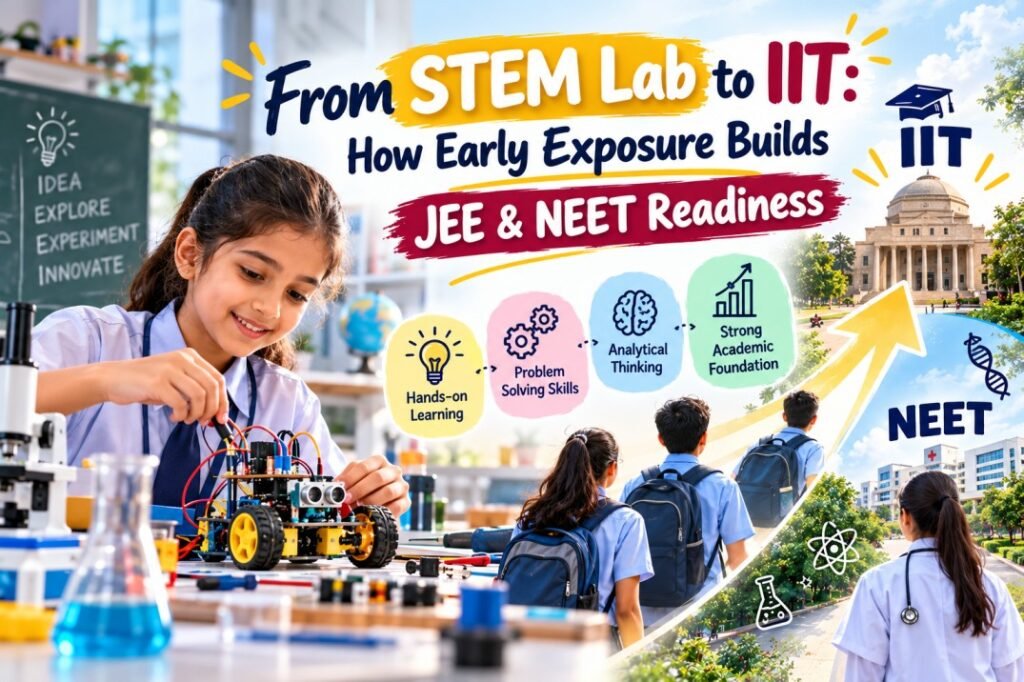
Ask any IIT or AIIMS student when their preparation really started, and many will say it was long before Grade 11. The concepts tested in JEE and NEET — mechanics, electricity, chemical bonding, cell biology, algebra and calculus — rest on foundations laid in Grades 6 to 10. Children who understood those basics deeply, rather than memorising them for a test, find the step up to competitive exam preparation far less daunting. This is where a strong JEE and NEET foundation begins: not with early coaching, but with curiosity, clear concepts and hands-on learning. Here is how early STEM exposure builds genuine JEE and NEET readiness, and how parents can support that journey at every stage. Grades 6–10The foundation years NCERT 11–12Basis of JEE & NEET 75%Class 12 marks for IIT/NIT eligibility DailySTEM Lab use at PGS The Exams Understanding JEE and NEET JEE Main is the national engineering entrance exam conducted by the National Testing Agency (NTA). It is the gateway to NITs, IIITs and other centrally funded institutions, and top-ranked candidates qualify for JEE Advanced, the exam for admission to the IITs. NEET-UG, also conducted by the NTA, is the single national entrance exam for MBBS, BDS and other undergraduate medical courses. JEE (Engineering) NEET-UG (Medical) Conducted by National Testing Agency (JEE Main); IITs (JEE Advanced) National Testing Agency Subjects Physics, Chemistry, Mathematics Physics, Chemistry, Biology Leads to NITs, IIITs, other centrally funded institutions; IITs via JEE Advanced MBBS, BDS and other undergraduate medical courses Syllabus base Largely NCERT Classes 11 and 12 Largely NCERT Classes 11 and 12 Why Early Matters Why the Foundation Years (Grades 6–10) Matter The CBSE curriculum is designed as a spiral: concepts introduced in middle school return in greater depth in Grades 9, 10, 11 and 12. A student who truly understands force and motion in Grade 9 will find rotational dynamics in Grade 11 manageable. One who only memorised formulas will struggle, and may spend Grade 11 relearning basics while classmates move ahead. Strong foundations in these years come down to three things: 💡Conceptual Clarity Understanding why a formula works, not just how to apply it. ➗Mathematical Fluency Comfort with fractions, ratios, algebra, geometry and graphs. 🔬Scientific Thinking The ability to form a hypothesis, test it and interpret the result. Learning by Doing What a STEM Lab Adds That Textbooks Cannot Textbooks describe phenomena; a STEM lab lets children see, measure and question them. When a student builds a pulley system, wires a simple circuit or tests acids and bases with indicators, an abstract idea becomes something they have experienced. That kind of understanding is exactly what the application-based questions in JEE and NEET reward. STEM Lab Activity (Middle School) Concept It Builds Where It Reappears Building levers, pulleys and simple machines Force, work, mechanical advantage JEE Physics — laws of motion, work–energy, rotational motion Wiring circuits with cells, bulbs and switches Current, resistance, series and parallel connections JEE and NEET Physics — current electricity Acid–base and indicator experiments Chemical reactions, pH, neutralisation JEE and NEET Chemistry — equilibrium and physical chemistry Observing plant and animal cells under a microscope Cell structure and function NEET Biology — cell biology and physiology Coding and data-logging activities Logic, sequencing, interpreting data JEE Mathematics — analytical problem-solving Measurement and error experiments Precision, units, significant figures JEE and NEET Physics — units, measurement and practical skills Our earlier post on how STEM education shapes future-ready children explains the PGS STEM Lab programme in more detail. Beyond Knowledge The Skills Competitive Exams Really Test JEE and NEET are not just knowledge tests. Strong candidates consistently combine four skills, and all four can be developed in school: 🧩Application Using a concept in an unfamiliar situation — which project-based STEM work trains directly. ⏱️Speed with Accuracy Built through regular, timed practice rather than last-minute cramming. 🧠Analytical Reasoning Breaking a complex problem into smaller, solvable steps. 📈Consistency Steady study habits sustained over two or more years. For Parents A Grade-by-Grade Roadmap for Parents Grades 6–8 Build Curiosity and Fundamentals Focus on enjoying Science and Mathematics. Encourage hands-on projects, reading and questions. Taking part in Science and Mathematics Olympiads at this stage builds problem-solving confidence without pressure. Heavy coaching is unnecessary here and often counterproductive. Grades 9–10 Strengthen the Core These years introduce the foundations of most Class 11 and 12 topics. Make sure your child genuinely understands NCERT Science and Mathematics, practises numerical problems regularly and builds good study habits. Strong Grade 10 board results also give students confidence going into the senior years. Grades 11–12 Focus and Balance With the choice of stream — PCM for engineering, PCB for medicine — preparation becomes more focused. Students need to balance board preparation with entrance preparation, practise with previous years’ papers and mock tests, and revise steadily. Board marks still matter: admission to IITs, NITs and IIITs generally requires at least 75% in Class 12 (65% for SC/ST candidates) or a top-20-percentile board score. Learn more about senior secondary education at PGS. Residential Advantage How Residential Life Supports Exam Preparation Preparing for JEE or NEET takes sustained effort over years. A structured residential routine — fixed study hours, supervised evening study, fewer distractions and no daily commute — can make that consistency easier to maintain. At PGS, residential students follow supervised evening study sessions with access to the labs and library. Read more about residential life at PGS. The PGS Approach How Prachin Global School Builds the Foundation A daily-use STEM Lab, plus dedicated Physics, Chemistry, Biology, Mathematics and Computer labs Hands-on CBSE practical work aligned with the NCERT syllabus Encouragement to take part in Science and Mathematics Olympiads and competitions A digital library with over 10,000 titles for independent study CBSE education from Nursery to Grade 12 on one campus, so foundations are built consistently year after year A Word of Caution — Avoid Burnout Early exposure should mean early curiosity, not early pressure. Children pushed into intensive coaching too young often lose interest in the very subjects
CBSE vs IB vs Cambridge — Which School Board Is Right for Your Child in Hyderabad? (2026 Comparison)
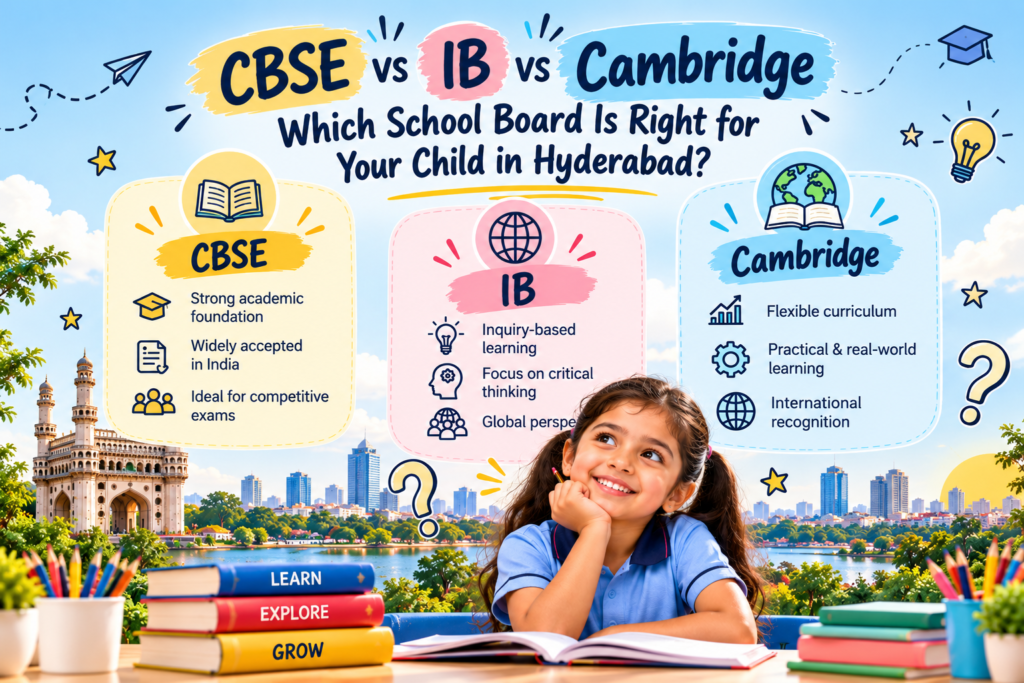
Hyderabad parents today have more choice of school board than any previous generation. Alongside the familiar CBSE and state boards, the city now has a growing number of schools offering the International Baccalaureate (IB) and Cambridge International curricula. If you are weighing CBSE vs IB vs Cambridge for your child, the decision can feel bigger than choosing a school, because the board shapes how your child learns, how they are assessed, and which doors open after Grade 12. This 2026 guide compares the three boards side by side — curriculum, assessment, entrance exam alignment, recognition and mobility — so you can choose the board that fits your child and your family’s plans, not just the one with the most impressive brochure. 30,000+CBSE-affiliated schools 3Boards compared NCERTBase of JEE, NEET & CUET Nursery–12CBSE at PGS The Basics Three Boards, Three Different Philosophies 📘CBSE — India’s National Board The Central Board of Secondary Education is India’s largest school board, with more than 30,000 affiliated schools across India and overseas. Its NCERT-based curriculum leads to board exams in Grades 10 and 12, and since NEP 2020 it has moved steadily towards competency-based, application-led learning. 🌐IB — The International Baccalaureate A Geneva-based foundation offering the PYP (ages 3–12), MYP (11–16), and the Diploma and Career-related Programmes (16–19). Learning is inquiry-led and interdisciplinary; Diploma students also complete Theory of Knowledge, an Extended Essay and CAS. 🎓Cambridge International Part of Cambridge University Press & Assessment, UK. Its pathway runs from Primary and Lower Secondary to IGCSE (ages 14–16) and AS & A Levels (16–19), and is known for wide subject choice and in-depth, exam-based assessment. Side by Side CBSE vs IB vs Cambridge — Side-by-Side Comparison Factor CBSE IB Cambridge Governing body Central Board of Secondary Education, India International Baccalaureate Organization, Geneva Cambridge University Press & Assessment, UK Learning approach Structured and NCERT-based, moving to competency-based learning under NEP 2020 Inquiry-based, interdisciplinary, student-led projects Subject-focused, flexible subject combinations, in-depth content Key assessments Grade 10 and Grade 12 board exams, plus internal assessment and practicals Internal assessments and final DP exams, plus Extended Essay and TOK IGCSE exams (around Grade 10) and AS & A Level exams JEE / NEET / CUET alignment Direct — entrance syllabi are based on NCERT Classes 11–12 Indirect — NCERT content usually needs separate preparation Indirect — NCERT content usually needs separate preparation Indian university recognition Accepted everywhere Accepted, with equivalence through the Association of Indian Universities (AIU) Accepted, with equivalence through the AIU Availability across India Largest network — easy transfers between cities Limited, mostly in large metros Moderate, mostly in large metros Best suited for Families planning higher education in India, or who may relocate within India Families planning undergraduate study abroad, with a child who enjoys self-directed work Families wanting subject flexibility, often with plans to study abroad Entrance Exams Entrance Exams — Where the Board Choice Matters Most For most Indian families, the biggest practical difference between boards shows up in Grades 11 and 12. India’s major national entrance exams — JEE Main for engineering, NEET-UG for medicine and CUET-UG for central university admissions — are conducted by the National Testing Agency, and their syllabi are drawn largely from NCERT content for Classes 11 and 12. A CBSE student prepares for the board exam and the entrance exam from the same textbooks. An IB or Cambridge student can certainly sit these exams, but usually has to study NCERT content separately, often alongside a demanding international programme. Board marks still count for JEE Admission to IITs, NITs and IIITs generally requires at least 75% in Class 12 (65% for SC/ST candidates) or a top-20-percentile score in the student’s board, in addition to the JEE rank. If there is a realistic chance your child will aim for an IIT, NIT, AIIMS or another top Indian institution, CBSE removes an entire layer of extra work. Relocation Mobility and Continuity Many Hyderabad families — especially those in IT, pharma and corporate roles — relocate within India at some point. With more than 30,000 CBSE schools across the country, a CBSE student can move cities and continue with the same curriculum and textbooks. IB and Cambridge schools are far fewer and concentrated in large metros, so a mid-school move can mean switching boards, which is disruptive at any age and especially in Grades 9 to 12. Making the Call Which Board Fits Your Family? When IB or Cambridge May Be the Better Fit Your family is firmly planning undergraduate study abroad, particularly in the UK, Europe or North America You are likely to relocate internationally during your child’s school years Your child thrives with a high degree of independence and open-ended, research-led work When CBSE Is the Strongest Choice Your child may aim for JEE, NEET, CUET or other Indian entrance exams You want a nationally recognised board with the widest choice of schools and colleges Your family may relocate within India You want a structured curriculum that is becoming more hands-on and application-based under NEP 2020 Many students also go on to study abroad successfully from CBSE schools, so this is a question of fit, not of ceiling. For most Hyderabad families, CBSE offers the best balance of academic rigour, flexibility and long-term options. That is why the question most parents eventually move on to is not which board, but which CBSE school. Next Step Choosing the Right CBSE School in Hyderabad Once you have settled on CBSE, the quality of the individual school matters more than the board itself. Whether you are searching for CBSE top schools in Hyderabad or comparing lists of the best schools in Hyderabad CBSE parents recommend, look beyond rankings. Check the affiliation status, board results over the last three years, lab infrastructure, teacher stability and the depth of the co-curricular programme. Our detailed guide to choosing the best CBSE school in Hyderabad walks through each of these. The PGS Approach Why Prachin Global School Chose CBSE At Prachin Global School (PGS), we follow the
10 Signs You’ve Found the Right CBSE School in Hyderabad
A practical checklist for parents comparing CBSE schools beyond the brochure. Hyderabad has no shortage of schools claiming to be among the best schools in Hyderabad CBSE has to offer — but glossy websites and long facility lists don’t always tell you what actually matters. After years of visiting campuses and talking with parents across the city, here are 10 genuine signs that a school is the right one, not just the most marketed one. 1 Teachers Who Have Been There for Years High teacher turnover is one of the clearest red flags in Indian schooling. Ask directly: how long have most teachers been at the school? Strong, stable schools retain their staff — because good teachers stay where they’re supported. 2 A Student-Teacher Ratio That Actually Holds Up Many schools quote an aspirational ratio on their website but run much larger classes in practice. Ask to sit in on a class, or simply count the students yourself during a campus visit. 3 Labs That Are Used, Not Just Displayed A STEM lab or science lab that’s spotless and empty during a tour is usually a lab that’s rarely used. Ask when it was last used, by which grade, and for what project. 4 Transparent, Verifiable Board Results The right school will happily share Grade 10 and Grade 12 pass percentages and average scores from recent years — not just headline toppers, but overall performance trends. 5 A Real Answer About Safety and Supervision Whether it’s a day school or residential campus, ask specifically who supervises students during unstructured time, and what the safeguarding protocol looks like. A confident, specific answer is a good sign; a vague one is not. 6 Co-Curricular Activity That Isn’t Just a Poster Sports, arts, and music shouldn’t be a once-a-term photo opportunity. Ask how often these activities actually run during a normal week. 7 A Curriculum Aligned with Where Students Are Headed For CBSE schools, alignment with NEP 2020 and clear preparation for competitive exams like JEE, NEET, and CUET is a strong signal that the school is genuinely preparing students for what comes after Grade 12. 8 Honest Admissions Conversations The right school’s admissions team will discuss both strengths and trade-offs honestly, rather than making every question sound like a sales pitch. 9 A Campus That Feels Lived-In, Not Just Photographed Genuine wear and use — a slightly scuffed sports field, well-thumbed library books — is often a better sign than an unnaturally pristine campus that never seems to have students in it during your visit. 10 Parents Who Speak Positively Without Being Asked Ask the admissions team to connect you with a few current parents. Schools confident in their community are usually happy to do this without hesitation. Where Prachin Global School Fits At Prachin Global School, we encourage every one of these questions during a campus visit — teacher tenure, lab usage, board results, and direct conversations with current parents. With over 1,800 students and 15 years of building trust with Hyderabad families, we’d rather you decide with real information than a brochure alone. Our complete parent’s guide to choosing a CBSE school covers the fuller picture if you’d like to go deeper. Related reading Best CBSE Schools in Hyderabad 2026 — A Complete Parent’s Guide CBSE School Admission Process 2026-27 in Hyderabad See these signs for yourself. Book a campus visit at Prachin Global School. Visit prachinglobalschool.com/admissions/ | Call +91 9393778778
How Residential Schools Support Student Health & Wellbeing
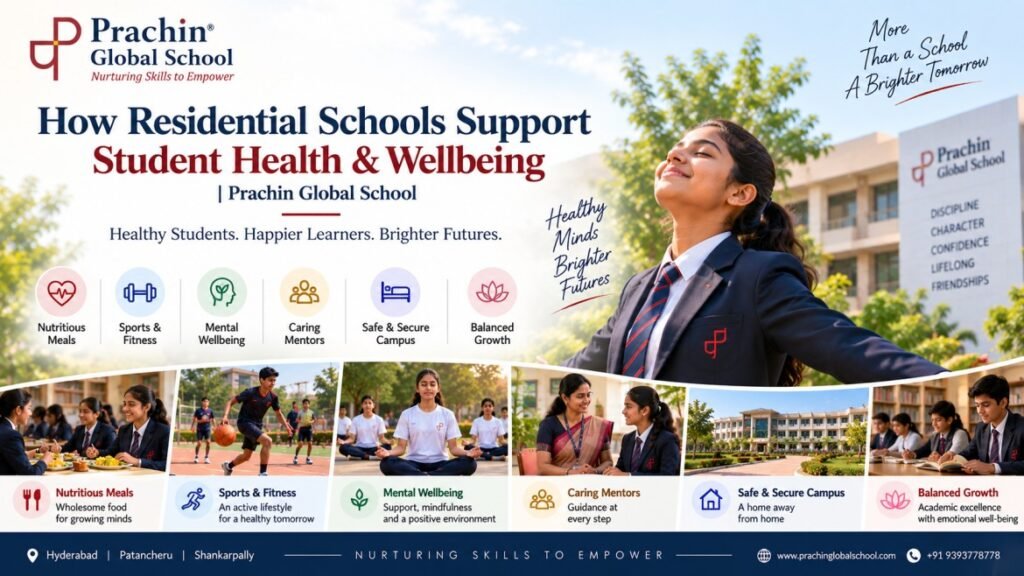
A closer look at how nutrition, sleep, safety, and emotional wellbeing are managed in a residential setting. When parents consider the best boarding schools in Hyderabad, academics and facilities usually top the list — but health and wellbeing deserve just as much attention. A residential school isn’t just responsible for a child’s education; it’s responsible for their daily physical and emotional wellbeing, every single day of the term. Why Wellbeing Looks Different in a Residential Setting At a day school, a great deal of a child’s physical and emotional care happens at home — meals, sleep routines, and emotional check-ins are managed by parents. In a residential school, the school itself takes on much of this responsibility. That’s a significant trust to place in an institution, and it’s worth understanding exactly how that trust is earned. Our post on a typical day for a residential student shows how this plays out hour by hour. 1 Nutrition Consistent, supervised, and balanced. Every meal — breakfast, lunch, evening snacks, and dinner — is nutritionist-supervised at PGS, regardless of what a typical home routine might look like during a busy week. 2 Sleep A predictable, healthy schedule. Fixed wake-up and lights-out times support academic performance and emotional regulation, without disruption from late-night screen time. 3 Physical Activity Built into the day, not an afterthought. With more available hours than a day scholar managing a commute, sport, yoga, and outdoor time are genuine daily habits. 4 Emotional Wellbeing Some homesickness in the first weeks is completely normal. Dedicated house parents who know each student individually make all the difference during this adjustment. 5 Safety & Supervision A secure campus with 24/7 staff oversight and clear safeguarding protocols means wellbeing is looked after outside of structured class time too. 6 Community The friendships formed in a residential environment create a natural emotional support system many students carry with them well beyond school. What This Looks Like at Prachin Global School At PGS, our residential programme is built around exactly these principles: nutritionist-supervised meals in a large dining hall, dedicated house parents for boys’ and girls’ boarding houses, a secure 7.5-acre campus with round-the-clock supervision, and a daily routine that balances academics, activity, and genuine rest. Parents new to residential schooling often start with our overview of the seven proven benefits of residential schooling before visiting campus. Related reading A Day in the Life of a PGS Residential Student Day School vs Residential School in Hyderabad — How to Decide See our residential facilities and meet our house parents in person. Visit prachinglobalschool.com/residential-life/ | Call +91 9393778778
Day School vs Residential School in Hyderabad — How to Decide What’s Right for Your Child
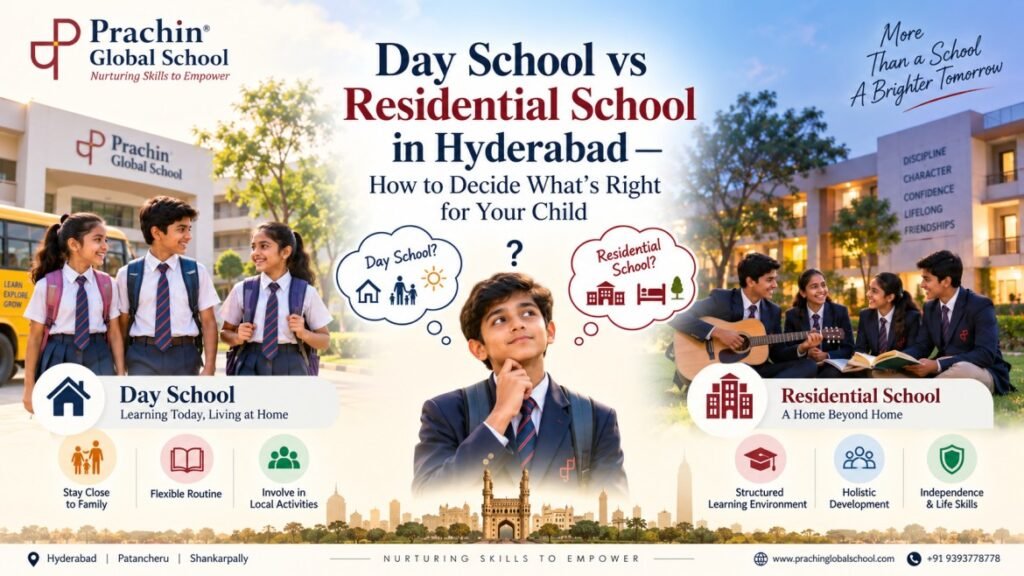
A practical, honest comparison to help Hyderabad parents choose the right format for their child. For many Hyderabad parents, the decision between a day school and a residential school isn’t about which is objectively “better” — it’s about which is better suited to their specific child, family routine, and long-term goals. Both formats can produce confident, well-rounded students. The right choice depends on a handful of honest questions most parents don’t get asked directly. What Actually Changes Between Day School and Residential School When families search for the best residential schools in Hyderabad, they’re often comparing on facilities and fees alone. But the deeper differences are structural: how the day is organised, how much independence a child builds, and how much day-to-day parental involvement is realistic given work schedules and travel distance. Factor Day School Residential School Daily structure Split between school and home Single consistent routine managed by the school Independence Builds gradually, often later Builds early, especially from Grade 6 onward Study consistency Varies with home environment Supervised evening study every day Family time Daily Weekends / scheduled visits Best suited for Younger children, home-oriented families Structure-seeking children, long commute situations 1. Daily Structure and Time Day school students split their day between school and home, with parents typically managing homework time, extracurricular scheduling, and bedtime routines. Residential students follow a single, consistent daily structure — set study periods, supervised evening revision, and consistent sleep schedules — managed by the school itself. Our post on a real day in the life of a residential student walks through exactly what this looks like, hour by hour. 2. Independence and Self-Management This is often the single biggest differentiator. Residential students, particularly from Grade 6 onward, develop independence at a noticeably faster pace: managing their own time, belongings, and small daily problems without a parent stepping in. Day school students typically build this independence later, often not until college. 3. Academic Consistency Among best boarding schools in Hyderabad, one advantage that consistently comes up is uninterrupted academic rhythm. Without the distractions of home — television, unstructured evenings, sibling activity — supervised study periods in a residential setting tend to be more consistent throughout the year, not just concentrated before exams. 4. Family Time and Emotional Considerations Day school naturally preserves more daily family time, which matters most for younger children and for families who value being closely involved in day-to-day school life. Residential school requires an adjustment period, and it’s not the right fit for every child or every family circumstance — this is worth an honest conversation before deciding, not after. 5. Cost of Commute vs Cost of Distance For families living far from strong day-school options — including many in the Patancheru and Shankarpally belt — a long daily commute has its own hidden cost: lost study time, tired evenings, and less time for extracurriculars. In these cases, a residential school closer to a good campus can actually mean more usable time for the child, not less. A Simple Way to Decide If your child thrives with routine and structure, and independence is a priority — residential schooling tends to suit them well. If your family values daily involvement and your child is younger or more home-oriented — day school may be the better current fit. If your commute is genuinely long (over 45–60 minutes each way), the time recovered through residential schooling is worth factoring in. If you’re unsure, a phased approach — visiting a residential campus, speaking with current residential parents, and observing a typical day — usually makes the decision much clearer. How Prachin Global School Supports Both Conversations At Prachin Global School, our admissions team regularly walks parents through exactly this decision — honestly, without steering families toward residential life if it isn’t the right fit yet. Our residential programme includes structured evening study, dedicated house parents, and a genuine home-away-from-home environment for students who are ready for it. Many parents also find it helpful to read about the seven proven benefits of residential schooling before making their decision. Related reading A Day in the Life of a PGS Residential Student How Residential Schools Support Student Health & Wellbeing Not sure which format is right for your child? Book a campus visit and speak with our admissions team. Visit prachinglobalschool.com/admissions/ | Call +91 9393778778
A Day in the Life of a PGS Residential Student — Real Routine, Real Stories
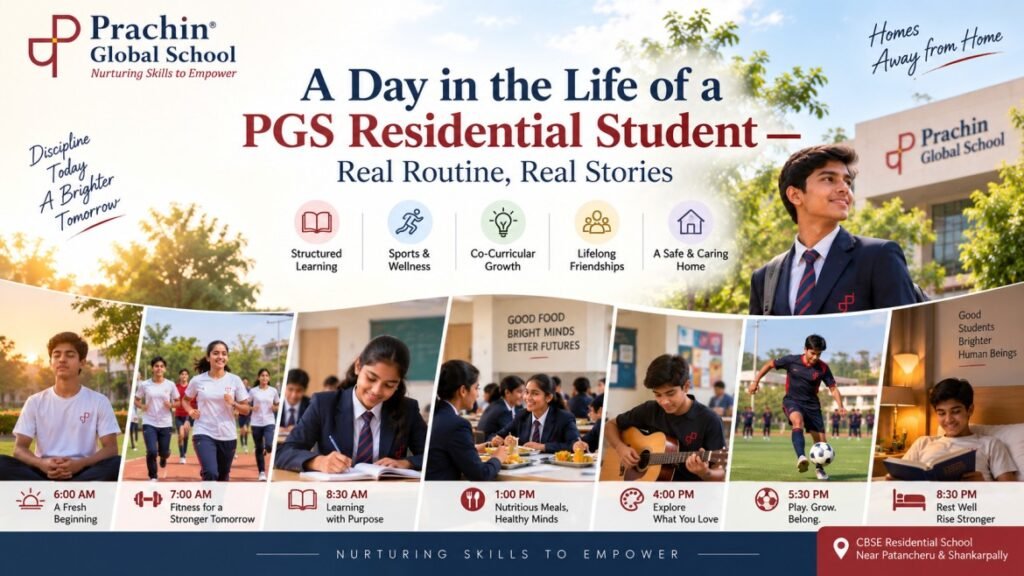
An honest, hour-by-hour walk-through of a typical weekday for a residential student at Prachin Global School. Parents researching residential schools in Hyderabad CBSE often have the same unspoken question: what does the day actually look like? Not the brochure version — the real one. Here’s an honest walk-through of a typical weekday for a residential student at Prachin Global School. If you’re still weighing this format against day school, our guide on how to decide between day school and residential school is a good place to start. 6:00 AM Wake-Up and Morning Routine The day begins early, but not rushed. Students wake up, freshen up, and head out for morning exercise — a mix of yoga, light fitness drills, and, for many, a favourite: a few laps around the sports field before breakfast. 7:30 AM Breakfast Meals are planned and supervised by professional nutritionists, so breakfast is balanced and consistent every single day — no skipped meals, no last-minute scrambling. 8:30 AM Classroom Learning Academic sessions run through the morning and early afternoon, following the full CBSE curriculum from Nursery through Grade 12. Residential students attend the same classes as day scholars — there’s no separate, lighter academic track for boarders. 1:00 PM Lunch and Midday Break A supervised lunch break gives students time to unwind, chat with hostel-mates, and recharge before afternoon activities. 3:30 PM Sports, Arts & Co-Curriculars This is where residential life often stands out most. With more available hours than a day scholar typically has, residential students get deeper, more consistent time in sports, performing arts, or STEM Lab projects — building both skill and genuine enjoyment, not just a once-a-week activity slot. 6:00 PM Evening Snacks and Supervised Study After a short break and evening snacks, the evening study period begins — supervised by teachers and house staff, with access to subject labs and the library. This structured academic rhythm is one of the biggest advantages residential families point to. 8:00 PM Dinner Another nutritionist-supervised meal, and for many students, dinner is also social time — catching up with friends from across grades in the dining hall. 9:00 PM Wind-Down and Lights-Out The evening winds down with quiet time before lights-out at a consistent hour every night — one of the most reassuring parts of residential life for many parents. What Parents Notice Most Parents who visit PGS during a scheduled campus tour often say the same thing: the routine feels calm, not regimented — structured enough to build discipline, but warm enough that students genuinely seem to enjoy their day. That balance is deliberate, and it’s built around dedicated house parents who know every residential student individually. Related reading Day School vs Residential School in Hyderabad — How to Decide How STEM Education Shapes Future-Ready Children Top Extracurricular Activities at CBSE Schools in Hyderabad Want to see a typical day for yourself? Book a campus visit and meet our current residential students and house parents. Visit prachinglobalschool.com/residential-life/ | Call +91 9393778778
Best CBSE Residential Schools in Hyderabad for Grade 11 & 12 | Prachin Global School Senior Secondary Best CBSE Residential Schools in Hyderabad for Grade 11 & 12 Choosing the Right Senior Secondary Boarding School Residential Programme · 5 min read · Prachin Global School Choosing among the best CBSE residential schools for 11th & 12th is a fundamentally different decision from choosing a boarding school for a younger child. By Grade 11, students are choosing academic streams, preparing for board examinations that shape college admissions, and often studying simultaneously for competitive entrance exams like JEE, NEET, or CUET. This guide covers what actually changes at the senior secondary level — and builds on our broader look at what makes a boarding school truly excellent if you’re comparing residential quality more generally. Why Senior Secondary Boarding Is a Different Decision At the senior secondary level, priorities shift towards academic intensity, exam readiness, and a settled, distraction-free environment during the two most consequential years of school. A residential setting that offers extended, supervised study hours and structured revision cycles can be a genuine advantage over a day-school schedule interrupted by commute time. What to Look for in a Grade 11–12 Residential Programme ✓ Stream-specific faculty depth Experienced subject teachers for Science, Commerce, or Humanities streams, not generalist staff stretched across grades. ✓ Extended, supervised study hours Senior students typically need longer, more flexible study blocks than younger residential students. ✓ Frequent access to labs for practicals Physics, Chemistry, and Biology practicals are core to CBSE Grade 11–12 assessment. ✓ Competitive exam alignment Curriculum pacing that genuinely supports JEE/NEET/CUET preparation, not works against it. ✓ Mentorship and stress support Board-exam years bring real academic pressure; look for structured mentoring, not just instruction. ✓ A settled peer community Students who boarded together through earlier grades transition into senior study with less disruption. How Prachin Global School Supports Grade 11 & 12 Residential Students PGS offers a full CBSE curriculum from Nursery through Grade 12, so our senior secondary residential students are part of an established community, not new arrivals adjusting to boarding life during their most demanding academic years. Our Physics, Chemistry, Biology, Mathematics, and Computer Science labs are in daily use — explore how this connects to our broader STEM education programme — supporting both classroom learning and CBSE practical examination preparation. 5Dedicated senior-secondary labs 12 yrsContinuous CBSE journey, Nursery–Gr.12 2Streams supported: Science & Commerce Questions Parents of Senior Secondary Students Should Ask How many periods per week are allocated to lab practicals in Grade 11 and 12? Is there a structured, supervised study block specifically for senior students? How does the school support students also preparing for competitive entrance exams? What mentoring or counselling support is available during board exam years? Choosing With the End Goal in Mind Grade 11 and 12 are not the years to change schools lightly. The right choice is a school whose academic rigour, lab access, and exam-focused structure are genuinely built for this stage. If you’d like the fuller admissions picture first, see our step-by-step CBSE admission guide. Related Reading What Makes a Boarding School Truly Excellent → How STEM Education Shapes Future-Ready Children → CBSE School Admission Process 2026-27 in Hyderabad → Discuss Grade 11 & 12 Admission Speak with our senior secondary faculty and see our labs in person. Talk to Admissions → Or call +91 9393778778
How STEM Education Shapes Future-Ready Children — The PGS Approach
STEMScience, Technology, Engineering, MathDailyPGS STEM Lab UseNEP 2020Aligned ProgrammeNIITEnglish Language Lab The jobs that today’s children will hold as adults have not yet been invented. This is not an exaggeration — it is the consensus of the World Economic Forum, educationists, and technology leaders globally. The skills required for the future — creative problem-solving, computational thinking, data literacy, engineering intuition — are precisely the skills that high-quality STEM education develops from an early age. For parents choosing a CBSE school in Hyderabad, STEM education has moved from a “nice to have” to an essential criteria. Here is why it matters, and how Prachin Global School’s STEM Lab programme is preparing students for the careers of tomorrow. What is STEM Education and Why Does It Matter? 🔬 What STEM Education Really Is STEM stands for Science, Technology, Engineering, and Mathematics. But quality STEM education is not simply teaching these subjects in isolation — it is about teaching students to think across disciplines, apply knowledge to real problems, prototype solutions, and learn from failure in a structured way. When a student in a STEM lab designs a simple bridge, codes a basic programme, or conducts a chemistry experiment with a real hypothesis and outcome, they are learning something that no textbook can teach: the experience of inquiry, discovery, and iterative problem-solving. 📋 STEM and the NEP 2020 Vision India’s National Education Policy 2020 specifically calls for the integration of vocational education, experiential learning, and STEM from the primary school level. CBSE has updated its curriculum and assessment frameworks in alignment with NEP 2020 to place greater emphasis on practical skills and project-based learning. Schools that have invested in proper STEM infrastructure — labs, equipment, and trained faculty — are already ahead of this curve. A well-equipped and actively used STEM lab is one of the strongest indicators of a school’s genuine commitment to modern education. The PGS STEM Lab — Learning by Doing The PGS STEM Lab — An Active, Daily-Use Facility At Prachin Global School, our STEM Lab is a lively, hands-on learning space designed specifically to ignite curiosity and build practical skills. Unlike many school labs that sit largely unused between formal practicals, the PGS STEM Lab is an active, daily-use facility. Students across all grade levels engage in regular STEM Lab sessions that complement their classroom curriculum with real-world challenges. 🧪 Hands-On Experiments Modern equipment reinforcing classroom theory with practical application across all science subjects. 📐 Project-Based Learning Multi-session challenges requiring research, design, building, testing, and presenting solutions. 💻 Technology Integration Coding activities, digital tools, and computational thinking exercises for the modern world. 🔭 Scientific Method Training Hypothesis, experiment, observation, conclusion — building the foundation of scientific thinking from primary school. ➗ Cross-Subject Learning Mathematics, Physics, and Computer Science explored together rather than in isolation. 🗣️ NIIT English Language Lab Professional-grade English communication skills — speaking, listening, writing, and presentation from Middle School onwards. Careers That STEM Education Leads To How Early STEM Education Opens Career Doors ✦Engineering and Technology — IIT, NIT, and private engineering colleges specifically test STEM aptitude in JEE. Early STEM exposure builds the intuition that JEE rewards.✦Medicine and Life Sciences — NEET preparation is built on strong Biology, Chemistry, and Physics foundations developed from school level.✦Data Science and Artificial Intelligence — Among the fastest-growing career fields globally, requiring mathematical and computational skills developed from school.✦Architecture and Design — Spatial thinking, mathematical precision, and creative problem-solving developed through STEM activities.✦Entrepreneurship and Innovation — STEM-educated students are more likely to identify problems and prototype solutions independently — the foundation of entrepreneurial thinking. Discover our STEM Lab and campus facilities in person. Book a visit to Prachin Global School — Hyderabad’s CBSE residential school with state-of-the-art STEM education. Call +91 9393778778.Enquire About Admissions 2026-27or call +91 9393778778 | Monday to Saturday, 9 AM – 4 PM
Best CBSE Schools in Hyderabad 2026 — A Complete Parent’s Guide
1,800+Students at PGS15 YrsExcellence Since 20107.5 AcCampus SizeK–12Nursery to Grade 12 Finding the right school for your child is one of the most important decisions you will ever make as a parent. In a city as vast and vibrant as Hyderabad, the options can feel overwhelming — hundreds of schools, dozens of boards, and a wide range of philosophies. If you have decided on the CBSE board, you have already made a strong choice. Now the question is: which is the best CBSE school in Hyderabad for your child? This guide is written specifically for Hyderabad parents researching schools for admissions in 2026-27. We cover what to look for, the key qualities that distinguish exceptional CBSE schools, and highlight what makes Prachin Global School a consistent choice for families across Hyderabad and Telangana. Why CBSE? Understanding the Board First Why CBSE? Understanding the Board Before Choosing a School The Central Board of Secondary Education (CBSE) is India’s most widely recognised school board, offering a structured, nationally standardised curriculum from Pre-Primary through Grade 12. CBSE is aligned with the New Education Policy (NEP 2020), which emphasises experiential learning, critical thinking, and the holistic development of every child. CBSE students have a clear advantage when it comes to national competitive examinations such as JEE (engineering), NEET (medicine), and CUET (central university admissions), as the curriculum is directly mapped to these entrance test syllabi. For parents with ambitions of their child attending top colleges, choosing a quality CBSE school in Hyderabad is a strategic decision. What to Look for in a CBSE School 6 Dimensions to Evaluate Every School On ✦Infrastructure and facilities — Does the school have modern labs, a library, a STEM lab, and sports facilities? Quality infrastructure signals long-term investment in student development.✦Teacher qualifications and stability — Are teachers qualified, experienced, and consistent? High teacher turnover is a red flag for any school.✦Student-teacher ratio — A lower ratio means more individual attention. Look for schools maintaining below 35:1. PGS maintains 30:1.✦Board exam results — Ask for Grade 10 and Grade 12 pass percentages and average scores over the last three years.✦Holistic development — Strong schools invest in sports, arts, music, and character development alongside academics.✦Residential options — For families outside Hyderabad or working parents, a quality residential programme can be transformative. Prachin Global School — Key Highlights Prachin Global School — One of the Best CBSE Schools in Hyderabad Prachin Global School (PGS), located near Patancheru and Shankarpally on a serene 7.5-acre campus, has established itself as one of the leading CBSE residential schools in Hyderabad. Since its founding in 2010, PGS has grown from 66 students to over 1,800 — a growth story driven entirely by parent trust and student outcomes. 🏫 7.5-Acre Campus L-shaped four-storey building accommodating 2,000+ students. Separate administrative block, auditorium, and multi-storey dining hall. 🔬 World-Class Labs STEM Lab, NIIT English Language Lab, Physics, Chemistry, Biology, Mathematics, and two Computer Labs — all in active daily use. 📚 Digital Library Over 10,000 titles in a modern digital library. Active use during school hours and supervised evening study sessions. 🏊 Sports & Recreation Two swimming pools, Football, Cricket, Basketball, Volleyball, Lawn Tennis, Skating, Table Tennis, Karate, Chess, and Yoga. 🎭 Arts & Culture Two music rooms, two dance studios (classical and western), two art studios, annual productions, and inter-school competitions. 🚌 GPS AC Buses GPS-enabled air-conditioned school buses with trained drivers, female attendants, and safety staff. Routes across Hyderabad. Questions to Ask on Every Campus Visit Ask These at Every School You Visit ✦What is the CBSE affiliation number and is it current and valid? (Verify at cbseaff.nic.in)✦What were your Grade 10 and Grade 12 board examination pass percentages last year?✦What is the average student-teacher ratio across all grade levels?✦Are the subject labs fully equipped and used regularly, or only for inspection purposes?✦What is the staff retention rate — how long have most teachers been at the school?✦What extracurricular activities are available and how often do they take place?✦For residential schools: who supervises students in the evenings and how is study time structured? Making the Right Decision for Your Child The best CBSE school in Hyderabad for your child is not necessarily the most expensive or the most famous — it is the school that fits your child’s personality, learning style, and long-term goals. Visit multiple campuses in person. Speak with current parents. Observe a classroom if permitted. Ask about the school’s vision, not just its fees. Admissions for 2026-27 are currently open at Prachin Global School. With over 15 years of building confident, curious, and capable students from Nursery to Grade 12, PGS is ready to welcome your family. Visit prachinglobalschool.com/admissions/ or call +91 9393778778 to book a campus tour and enquire about CBSE school admissions 2026-27 in Hyderabad.Enquire About Admissions 2026-27or call +91 9393778778 | Monday to Saturday, 9 AM – 4 PM
